2.7 先祖と子孫(親と子)
- ある単語から見てrootに近い方の単語を先祖(ancestor)、その単語からrootに遠い単語を子孫(children)と呼ぶ。
- 以下は依存木を異なる表現で表したもので、図の最も上にrootがあり、統率されている単語は下に示されている。
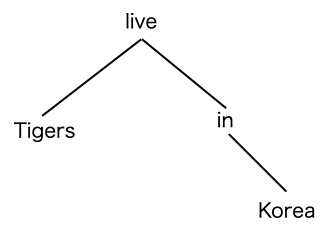
- この図で、"live"は"Tigers"の先祖、"Korea"は"in"の子孫ということが上下関係で示されている。
import spacy
from spacy import displacy
nlp = spacy.load("en_core_web_sm")
text = "Sentence Detection is the process of locating the start and end of sentences in a given text. This allows you to you divide a text into linguistically meaningful units. You’ll use these units when you’re processing your text to perform tasks such as part of speech tagging and entity extraction."

doc = nlp(text)

for s in doc.sents:
    print(s)
Sentence Detection is the process of locating the start and end of sentences in a given text.
This allows you to you divide a text into linguistically meaningful units.
You’ll use these units when you’re processing your text to perform tasks such as part of speech tagging and entity extraction.
text = "I'm in London, you're in Paris."

doc = nlp(text)

for token in doc:
    print(token)
I
'm
in
London
,
you
're
in
Paris
.
doc = nlp("So shall we try to plan a rendevous vacay?")
for token in doc:
    print(token, token.tag_,token.pos, spacy.explain(token.tag_))
So RB 86 adverb
shall MD 87 verb, modal auxiliary
we PRP 95 pronoun, personal
try VB 100 verb, base form
to TO 94 infinitival "to"
plan VB 100 verb, base form
a DT 90 determiner
rendevous JJ 84 adjective (English), other noun-modifier (Chinese)
vacay NN 92 noun, singular or mass
? . 97 punctuation mark, sentence closer
doc = nlp("Tigers live in Korea.")

for token in doc:
    print(token.text,token.dep_)
Tigers nsubj
live ROOT
in prep
Korea pobj
. punct
displacy.render(doc)
doc = nlp("The really tall giraffe at the zoo ate the green leaves off the tree.")
displacy.render(doc)
# "giraffe"の左側にあって、"giraffe"が直接統率している語
for token in doc[3].lefts:
    print(token.text)
The
tall
# "giraffe"の左側にあって、"giraffe"が直接統率している語の品詞
for token in doc[3].lefts:
    print(token.pos_)
DET
ADJ
# "giraffe"の左側にあって、"giraffe"が直接統率している語
for token in doc[3].rights:
    print(token.text)
at
# 祖先の抽出
T = []
A = []

for token in doc:
    T.append(token)
    tmp = []
    for a in token.ancestors:
        tmp.append(a)
    A.append(tmp)
import pandas as pd
df_a = pd.DataFrame({"ancestors":A},index=T)
df_a
| ancestors | |
|---|---|
| The | [giraffe, ate] |
| really | [tall, giraffe, ate] |
| tall | [giraffe, ate] |
| giraffe | [ate] |
| at | [giraffe, ate] |
| the | [zoo, at, giraffe, ate] |
| zoo | [at, giraffe, ate] |
| ate | [] |
| the | [leaves, ate] |
| green | [leaves, ate] |
| leaves | [ate] |
| off | [ate] |
| the | [tree, off, ate] |
| tree | [off, ate] |
| . | [ate] |
# 子孫の抽出
T = []
C = []

for token in doc:
    T.append(token)
    tmp = []
    for c in token.children:
        tmp.append(c)
    C.append(tmp)
df_c = pd.DataFrame({"children":C},index=T)
df_c
| children | |
|---|---|
| The | [] |
| really | [] |
| tall | [really] |
| giraffe | [The, tall, at] |
| at | [zoo] |
| the | [] |
| zoo | [the] |
| ate | [giraffe, leaves, off, .] |
| the | [] |
| green | [] |
| leaves | [the, green] |
| off | [tree] |
| the | [] |
| tree | [the] |
| . | [] |
I sent John the letter yesterday.
../DATA01/sentences.txtには約1000文が含まれています。import pandas as pd
import matplotlib.pyplot as plt
%matplotlib inline
# 仮のデータ
D = {"A":25,"B":322,"C":66,"D":120,"E":95}
# データフレームに変換
df = pd.DataFrame.from_dict(D,orient="index",columns=["frequency"])
# 降順に並べ替え
df2 = df.sort_values(by="frequency",ascending=False)
df2.head(10)
| frequency | |
|---|---|
| B | 322 |
| D | 120 |
| E | 95 |
| C | 66 |
| A | 25 |